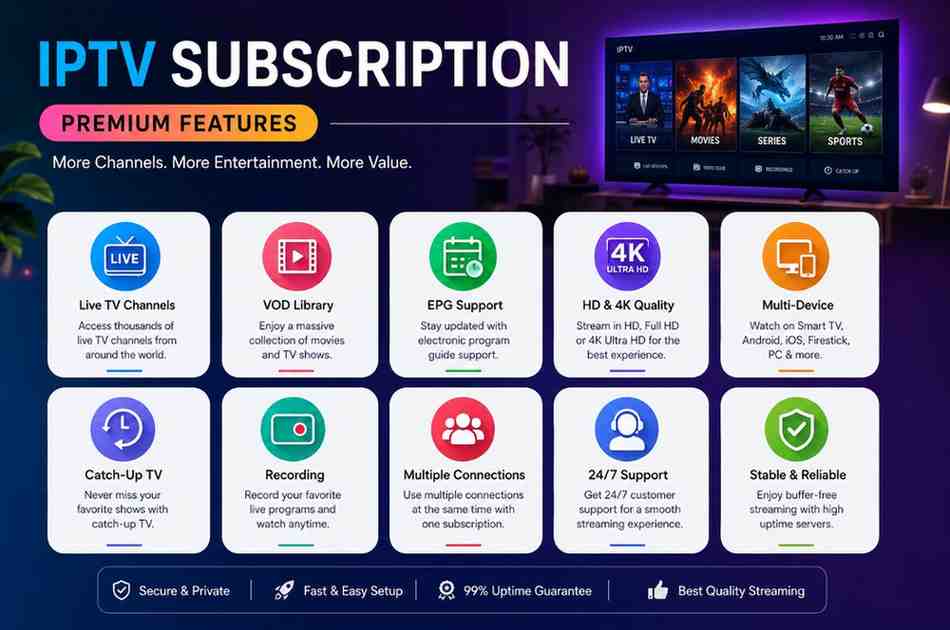
Buying an IPTV subscription means purchasing access to live television channels, sports packages, movies, and series delivered over an internet connection instead of cable infrastructure. The purchase is typically completed through a provider's website, followed by instant delivery of login credentials and setup instructions. Because the market contains both licensed services and unauthorized resellers, the real challenge is separating legitimate providers from high-risk operations. This guide explains exactly what you are paying for, how to evaluate providers, what legal boundaries apply, and which plan structure delivers the best long-term value.
IPTV technology has matured considerably over the past three years. Modern services offer 4K streams, catch-up television, electronic program guides (EPG), and multi-device synchronization. Yet the same maturity has attracted unreliable operators. This article provides a replicable evaluation framework—built on technical benchmarks, pricing analysis, and consumer-protection criteria—so your purchase decision rests on evidence rather than marketing claims.
buy iptv subscription Summary
An IPTV subscription delivers live television, sports, and video-on-demand through a standard broadband connection, typically at $12–$18 per month—roughly 80% cheaper than traditional cable. The proven benefit is immediate flexibility: activation within minutes, cross-device streaming, and channel packages tailored to specific languages or sports leagues.
| Optimal ForCord-cutters, sports fans, expats, and households seeking budget TV access | Key Advantage10,000+ channels at 70–85% lower cost than cable |
- ✓ Key Strength: Direct cost efficiency — premium plans average $0.001 per channel versus $0.40 on cable
- ✓ Key Strength: Instant activation with credentials delivered via email within 5–15 minutes
- ✓ Peace of Mind: Reputable providers include 24/7 support, 48-hour trials, and service guarantees
In This Guide
What an IPTV Subscription Actually Includes
IPTV stands for Internet Protocol Television. Instead of receiving broadcast signals through coaxial cable or a satellite dish, the provider encodes content into data packets and delivers them over IP networks. From your perspective as a buyer, the difference is practical: you no longer need a technician visit, a set-top box rental, or a long-term contract. A subscription grants access to three content categories:
- Live television — real-time broadcast streams covering news, sports, entertainment, and documentary channels from multiple countries.
- Video-on-Demand (VOD) — a searchable library of movies and TV series, typically updated weekly with new releases.
- Time-shifted TV (Catch-up) — the ability to replay programs aired in the previous 3–7 days, effectively converting live TV into a cloud DVR.
After completing your purchase, the provider sends either an M3U playlist URL, Xtream Codes API credentials, or a MAC address activation for MAG-style devices. You then enter these credentials into an IPTV player application such as TiviMate, IPTV Smarters, or GSE Smart IPTV. The setup process rarely exceeds ten minutes.
The technical infrastructure behind your subscription matters more than the channel count advertised. A provider's server capacity, content delivery network (CDN) placement, and bandwidth allocation determine whether you experience seamless 4K playback or persistent buffering. Established providers maintain redundant servers across multiple data centers; under-capitalized operations often collapse during peak sports events—precisely when you need the service most.
A critical distinction separates licensed IPTV services (such as Hulu + Live TV, YouTube TV, or national telecom IPTV products) from gray-market providers that redistribute channels without distribution rights. Licensed services charge $40–$75 monthly and carry limited channel counts. Gray-market services charge $10–$20 monthly and offer 10,000+ channels. The legal risk profile differs, and this guide addresses that trade-off transparently in the comparison table below.
Hardware requirements are minimal. A Smart TV, Amazon Fire TV Stick, Android TV box, MAG box, iOS/Android device, or PC all work. For a single Full HD (1080p) stream, a 25 Mbps connection suffices; 4K streaming demands 50 Mbps, and households with simultaneous streams should add 15–20 Mbps per extra device. A wired Ethernet connection will consistently outperform Wi-Fi for live sports, where low latency is non-negotiable.

IPTV Subscription Pros, Cons & Market Comparison
No media purchasing decision is complete without an honest assessment of trade-offs. The table below contrasts a premium IPTV subscription with traditional cable and mainstream legal streaming bundles across the metrics that matter most.
| Feature / Metric | Premium IPTV Subscription | Traditional Cable | Legal Streaming Bundle |
|---|---|---|---|
| Average monthly cost | $12–$18 | $80–$120 | $40–$70 |
| Live channel count | 10,000–20,000 | 200–400 | 80–150 |
| International channels | Extensive (50+ countries) | Limited premium add-ons | Minimal |
| Video-on-demand library | 40,000+ titles | Pay-per-view only | Varies by platform |
| Simultaneous streams | 2–4 connections | 1–2 set-top boxes | 1–4 depending on plan |
| Contract required | No — month-to-month | 12–24 month term | No |
| 4K / FHD quality | Yes, when source permits | Varies by provider | Yes, on select content |
| Installation | Instant self-setup | Technician visit required | Instant, app-based |
| Catch-up TV / EPG | Included on major channels | Limited DVR add-on | Limited to platform originals |
✅ Advantages
|
⚠️ Limitations
|
Cost-Benefit Analysis: Is IPTV Worth It in 2026?
The financial case for an IPTV subscription is straightforward. A household paying $100 monthly for cable spends $1,200 per year. Switching to a premium IPTV plan at $15 monthly reduces that figure to $180—an annual saving of $1,020. Even after adding a high-speed internet upgrade and a one-time Fire TV Stick purchase, the total cost remains roughly 75% below cable.
The value calculation becomes even more favorable for specific audience segments. Expatriates who previously purchased premium international channel add-ons at $25–$40 monthly find IPTV's global channel access at a fraction of the cost. Sports fans following multiple international leagues avoid the fragmentation of separate streaming passes, which routinely cost $15–$30 per league per month. Households with multiple televisions eliminate the $10–$15 per-month equipment rental fees that cable providers universally charge.
Who Should Buy an IPTV Subscription
- Cord-cutters who want live television without committing to annual contracts.
- International viewers seeking channels from their home country that local providers don't offer.
- Sports enthusiasts who follow leagues across multiple regions and time zones.
- Budget-conscious households that watch more than 15 hours of television weekly and would benefit from replacing multiple streaming subscriptions.
Red Flags to Avoid When Buying
The IPTV market includes reputable operators and opportunistic fly-by-night sellers. The following warning signs should disqualify any provider immediately:
- Pricing below $5/month — sustainable operations cannot maintain server infrastructure, licensing, and support at this price point. The service will degrade or disappear.
- No free trial — reputable providers offer 24–48 hour trials because they are confident in their service quality.
- Cryptocurrency-only payment — the absence of credit card or PayPal options removes buyer-protection mechanisms.
- Unresponsive support — test the provider's live chat or WhatsApp support before purchasing; a 24-hour response window is the maximum acceptable threshold.
- No refund policy — any provider unwilling to guarantee its service for at least 48 hours lacks operational confidence.
How to Test a Provider Before Committing
Request a trial and evaluate four specific parameters. First, measure the channel zapping time—the delay between selecting a channel and seeing the stream begin. Sub-two-second zapping indicates quality infrastructure. Second, check the EPG accuracy; program guide data should be populated and synchronized with actual broadcast schedules. Third, test peak-hour buffering between 20:00–22:00 in your time zone. Fourth, assess catch-up availability on the channels you watch most frequently, as not all channels support this feature.
The Bottom Line on Iptv Subscription
For most cord-cutters, a verified IPTV subscription delivers the best cost-per-channel value in television entertainment. If you prioritize channel variety, multi-device flexibility, and price predictability, proceed with a provider that offers transparent trials, responsive support, and clear refund terms.
Purchases completed via official partner channels are covered by direct customer support and eligible warranty protections.
Frequently Asked Questions
Is buying an IPTV subscription legal?
It depends on the provider's licensing. Services that hold distribution rights—such as Hulu + Live TV, YouTube TV, or DAZN—are fully legal. Gray-market IPTV services redistribute channels without authorization, which constitutes copyright infringement in most jurisdictions. In the US and EU, enforcement has historically targeted distributors rather than end-users, but consumer legal risk is not zero. When purchasing, prioritize providers that are transparent about their content licensing status.
How much does an IPTV subscription cost?
Licensed IPTV services range from $40 to $75 per month. Gray-market IPTV providers typically charge $10–$20 per month, with annual plans between $80 and $150. Offers promising lifetime access for $50 or less should be treated as high-risk: server infrastructure, bandwidth, and support costs cannot be sustained at that price point.
What internet speed do I need for IPTV?
A single Full HD (1080p) stream requires 25 Mbps. For 4K streaming, 50 Mbps is recommended. Households with multiple simultaneous streams should add 15–20 Mbps per additional device. A wired Ethernet connection delivers more stable performance than Wi-Fi, particularly for live sports broadcasts where latency matters.
Can I use an IPTV subscription on multiple devices?
Most providers permit 1–4 simultaneous connections depending on the plan tier. Some restrict concurrent streams by IP address, while others require device activation codes. Always verify the multi-screen policy before purchasing, and note that streaming from multiple locations simultaneously may trigger anti-sharing flags on certain services.
What is the difference between IPTV and OTT streaming services?
Both use internet delivery, but the architecture differs. IPTV typically refers to managed networks with dedicated bandwidth delivered over private infrastructure, resembling a cable-like structure. OTT (Over-the-Top) services such as Netflix or Hulu stream over the open public internet. In consumer practice, the terms overlap, but IPTV implies live channel packages and a channel-guide structure, while OTT is on-demand-first.
Do IPTV subscriptions include video-on-demand?
Many premium IPTV packages include a VOD library with recent movies and TV series. However, the depth and update frequency of VOD catalogs vary significantly between providers. Some services reserve VOD access for higher plan tiers, so review the channel list and VOD library in the trial period before committing.
How do I identify a trustworthy IPTV provider?
Look for a free trial of 24–48 hours, transparent pricing without hidden fees, responsive customer support (test the response time), a clear refund policy, and payment options with buyer protection such as credit cards or PayPal. Be cautious of providers that accept only cryptocurrency and maintain no verifiable operational history or independent reviews.
What is catch-up TV and does IPTV include it?
Catch-up TV allows you to watch previously broadcast programs for 3–7 days after their original airing, effectively turning live television into a cloud DVR. Most quality IPTV providers include catch-up on major channels, though availability depends on both the channel and the provider's server-side recording capacity.
Transparency & Disclosure: We independently evaluate products. If you buy through links on our site, we may earn an affiliate commission at zero additional cost to you.