This article contains affiliate links. If you buy through them, we may earn a commission at no extra cost to you. Learn more.
Buyer's Guide
Choosing an IP-TV provider means weighing channel selection, streaming reliability, and legal coverage. This guide explains exactly what IP-TV is, how it works, how to evaluate providers, and whether it makes sense for your setup — before you spend a cent.
In Brief
- IP-TV delivers live television over an internet connection rather than cable or satellite, often at a lower monthly cost.
- Reliability and channel selection vary widely between providers; a high-quality provider with stable servers matters more than the cheapest price.
- Not all IP-TV services operate with proper content licenses — verifying legal standing is essential before subscribing.
- Most users pair IP-TV with a VPN for privacy and to reduce ISP throttling during live sports or 4K streams.
Table of Contents
If you are searching for an ip-tv provider, you likely want live television without the rigid contracts and high monthly fees of traditional cable. The short answer is that IP-TV (Internet Protocol Television) delivers live and on-demand content through your broadband connection, and a good provider gives you hundreds of channels, including sports and international programming, for a fraction of what cable costs. But the market is crowded, and not every provider delivers what they promise.
This guide breaks down exactly what an IP-TV provider is, how streaming works behind the scenes, the real benefits and trade-offs, and how to choose a service that will actually hold up during the big game or your evening news. We cover the technical basics in plain English, compare IP-TV with alternatives like cable and subscription services, and answer the questions people ask most often. By the end, you will know whether IP-TV fits your household and which factors to prioritize when comparing providers.
What Is an IP-TV Provider?
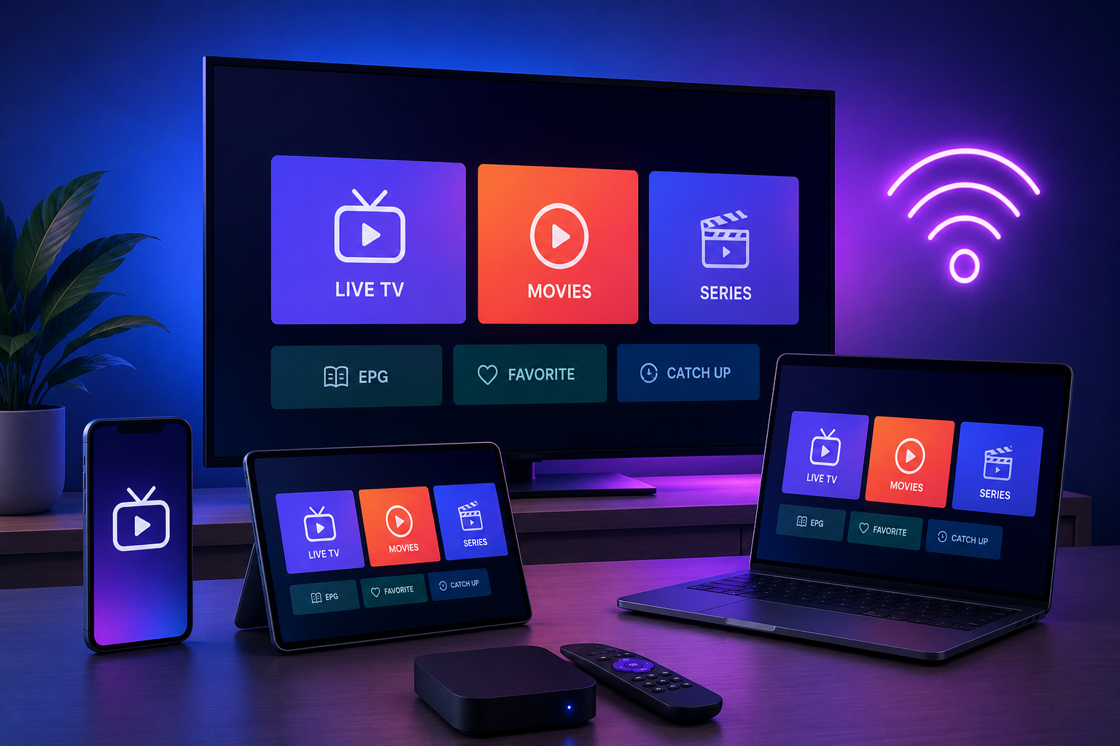
An IP-TV provider is a company that transmits live television channels and on-demand video content over an internet protocol network — your home broadband — rather than through traditional broadcast methods like satellite, cable, or terrestrial antennas. Think of it as streaming your cable subscription: you get a channel lineup, an electronic program guide (EPG), and often a DVR-like catch-up feature, but everything arrives through the same pipe that delivers Netflix and YouTube.
The key difference between IP-TV and standard streaming services is that IP-TV focuses on live broadcast channels — news, sports, entertainment — in real time, just like you would get from a cable box. Many providers also include video-on-demand libraries with movies and series, but the core offering remains live linear television.
How Providers Differ From One Another
Not all IP-TV providers are created equal. Some operate with proper content licensing agreements, paying broadcasters for the right to carry their channels. Others operate in a legal grey area, reselling access to streams without authorization — these are the services you often see discussed on Reddit or Telegram that disappear without warning. A legitimate ip-tv provider will be transparent about its licensing, offer stable streaming servers, and provide customer support that actually responds. Pricing typically ranges from $10 to $40 per month, depending on the number of channels and the quality of the infrastructure.
How IP-TV Works, Step by Step
Related Reading: How to Get an iptv Free Trial Step-by-Step for Beginners
Understanding the basic flow helps you diagnose problems and choose a provider with infrastructure that matches your needs. Here is how the process works from broadcast source to your screen:
- The provider receives broadcast signals. The IP-TV provider captures live feeds from satellite, terrestrial, or direct fibre feeds — same signals that cable companies receive.
- Video is encoded and transcoded. Raw video is compressed into a digital format (typically H.264 or H.265) at multiple bitrates so it can adapt to your connection speed.
- Streams are sent to servers. The encoded video is distributed to content delivery network (CDN) servers located in data centres closer to subscribers. A provider with multiple server locations reduces buffering.
- You connect via an app or M3U URL. On your device — a smart TV app, Android box, Fire Stick, phone, or computer — you enter a subscription URL or download the provider's custom app. The app contacts the provider's server to authenticate and pull down the channel list.
- Video is decoded and displayed. The app receives the video stream, decodes it in real time, and displays it on your screen. If your internet connection drops below the required speed, the player switches to a lower resolution to keep the stream alive.
Real-World Benefits of Using an IP-TV Provider
Why would someone switch from cable or a satellite dish to an IP-TV provider? The advantages go beyond price, though cost is often the primary reason people start looking.
Lower monthly cost. A decent cable package in the US or UK can run $80–$120 per month. A mid-tier IP-TV subscription typically costs $15–$25 for hundreds of channels, including many that would be in premium cable tiers. For international channels — European, Asian, Middle Eastern — IP-TV is often the most affordable way to access content outside your region.
No long-term contracts. Most IP-TV providers operate on a month-to-month basis. You pay for one month, and if the service does not meet your expectations, you cancel without early termination fees. This flexibility makes it easy to try different services or switch between them based on sports seasons or content availability.
Multi-device access. A single subscription often allows simultaneous connections on multiple devices — your living room TV, a tablet in the kitchen, and a phone on the go. Some providers offer four or five simultaneous streams, so different family members can watch different channels at the same time.
International channel packages. If you want access to live TV from your home country while living abroad, an IP-TV provider with a strong international lineup is often the only practical option. Many services specialize in packages for specific regions — South Asian, Arabic, Latin American, European — at prices that undercut traditional satellite services.
Honest Limitations to Consider
Related Reading: Prostadine Reviews: 5 Myths That Are Sabotaging Your Results
IP-TV is not a perfect replacement for cable in every situation. Being aware of the downsides before you subscribe will save you frustration.
Buffering and reliability depend entirely on your internet connection. Unlike cable TV, which delivers video over a dedicated line, IP-TV shares your general broadband connection. If your household has multiple people streaming, gaming, and video-calling simultaneously, live TV streams can stutter or drop. A minimum of 25 Mbps for standard definition and 50 Mbps for 4K content is generally recommended, but peak-time congestion can still cause issues.
Provider stability can be shaky. The IP-TV market has a high churn rate. Services that seem solid one month may disappear the next, especially those operating without proper licenses. Even well-established providers occasionally face server outages during high-demand events like major football matches or the Oscars. A reliable ip-tv provider with a proven track record and responsive support is worth paying slightly more for.
Device compatibility can be inconsistent. While most providers support apps for Android TV, Fire TV, iOS, and Android phones, support for Apple TV, Samsung smart TVs (Tizen), or LG webOS is less universal. You may need to buy a streaming box like a Fire Stick or Android TV box to use the service on your main television. Always check supported platforms before subscribing.
Legal grey areas exist. This is the biggest caveat. Many IP-TV providers do not have proper licensing agreements with content owners. Subscribing to an unlicensed service carries risks — the provider can be shut down overnight, and in some jurisdictions, there have been cases where end users received warning letters or fines, though enforcement varies widely. We cover how to assess legality later in this guide.
When selecting an IP-TV provider, the three factors that matter most are server infrastructure, licensing transparency, and device support — price alone is a misleading metric.
IP-TV vs Cable vs Streaming Services
To help you decide, here is a direct comparison of how an IP-TV provider stacks up against traditional cable and live TV streaming services like YouTube TV, Hulu + Live TV, and Sling TV.
| Feature | IP-TV Provider | Cable/Satellite | Live TV Streaming (YouTube TV etc.) |
|---|---|---|---|
| Monthly cost | $10–$40 | $70–$150 | $40–$75 |
| Contract length | Month-to-month | 1–2 year contract | Month-to-month |
| Channel count | 200–1,000+ | 100–300 | 50–100 |
| Sports coverage | Wide (incl. international) | Regional restrictions apply | Major leagues, some RSNs |
| Legal certainty | Varies by provider | Fully licensed | Fully licensed |
| DVR / catch-up | Often included | Extra fee for DVR | Unlimited cloud DVR |
| Reliability | Moderate (depends on ISP) | High (dedicated line) | High (major CDNs) |
As the table shows, IP-TV wins on price and channel volume but loses on reliability and legal certainty. Cable and live streaming services are more predictable but cost significantly more. The choice depends on what you value most: maximum content for the lowest price, or peace of mind with consistent quality.
Pros & Cons of IP-TV at a Glance
✓ Pros
- Significantly lower monthly cost than cable or satellite
- Massive channel selection including international options
- No long-term contracts or early termination fees
- Watch on multiple devices simultaneously
- Catch-up and EPG features included in most plans
✗ Cons
- Buffering and stream quality depend on your internet speed
- Provider reliability can be inconsistent
- Legal status varies — unlicensed providers may be shut down
- Not all services support Apple TV or LG/Samsung smart TVs natively
- Customer support quality is often lower than major streaming services
Who an IP-TV Provider Is Right For
Related Reading: Free Best Buy Gift Card Balance: Honest Review
Different users have different needs. Here are the three main user profiles for which an ip-tv provider makes sense, and one group that should probably stick with traditional services.
Sports fans on a budget. If you follow multiple leagues across different countries — Premier League, Champions League, NFL, NBA, cricket — an IP-TV provider with a comprehensive sports package is often the most affordable way to access them all. A single $20–$30 monthly subscription can cover sports channels that would cost $60+ per month on cable or require separate league passes that add up quickly. Just be prepared for the possibility of buffering during peak match hours, especially if your broadband speeds are on the lower side.
Expatriates and multilingual households. People living outside their home country often struggle to find live TV in their native language. IP-TV providers that specialize in regional content — Indian, Turkish, Arabic, Filipino, Latin American — deliver hundreds of channels that are either unavailable through conventional services or cost a premium. For these users, an IP-TV provider with a dedicated international package is often the only practical solution.
Cord cutters who want flexibility. If you already cancelled cable and use a mix of Netflix, Disney+, and Amazon Prime, but miss the experience of channel-surfing live news or catching a game without planning ahead, IP-TV fills that gap without lock-in contracts. It is a supplementary service you can activate during football season and pause during the summer.
Households that need absolute reliability (and have the budget for it) — families with elderly members who rely on TV, or people who cannot tolerate any downtime — are better served by a major live TV streaming service like YouTube TV or a traditional cable connection. The occasional outage or buffering event that an IP-TV user accepts as normal would be a dealbreaker for this group.
How to Get Started With an IP-TV Provider
If you decide IP-TV is right for you, here is a five-step process to get up and running without wasting money on a service that does not work for your setup.
- Check your internet connection. Run a speed test from the device you plan to use for streaming. You need at least 25 Mbps for reliable HD streaming and 50 Mbps if you want 4K content. If your connection is slower or unstable, consider upgrading your plan or using a wired Ethernet connection instead of Wi-Fi.
- Research providers with trial options. Look for an ip-tv provider that offers a 24-hour or 7-day trial for a nominal fee (typically $2–$5). Read reviews on dedicated forums and Reddit communities to see what real users say about buffering during peak hours. Pay attention to comments about server locations — providers with servers closer to your region generally perform better.
- Verify supported devices. Before signing up, confirm that the provider offers a native app for your TV platform (Android TV, Fire TV, Apple TV, Samsung Tizen) or works with third-party players like TiviMate, IPTV Smarters, or VLC. If you do not have a compatible device, a $30–$50 Android TV box is a worthwhile investment.
- Use a VPN for privacy. Many users pair IP-TV with a VPN to prevent their ISP from throttling streaming traffic — some providers intentionally slow down video streams during peak times. A VPN also adds a layer of privacy, particularly if you are using a provider whose legal status is unclear. Choose a VPN with servers in the same region as your provider's streams to minimize latency.
- Start with a short subscription. Do not commit to a 12-month plan with any provider you have not tested. Buy one month, evaluate the channel quality, EPG accuracy, and buffering during your most important viewing times. If the experience meets your expectations, you can then consider longer commitments that often come with a discount.