This article contains affiliate links. If you buy through them, we may earn a commission at no extra cost to you. Learn more.
The Breakdown
Setting up an ip-tv provider takes about 15 minutes once you know the order. Here is exactly what to do — choosing a legal service, installing the app, and testing stability before you pay.
In Brief
- An ip-tv provider streams live TV and on-demand video over your broadband — no dish, aerial, or cable box needed.
- You can finish the full setup in about 15 minutes with a Fire TV Stick, Android device, phone, or smart TV.
- Two conditions prevent most buffering problems: a stable 25 Mbps connection and a verified legal provider.
- Always test with a free trial or one-month plan before you commit to a longer, more expensive subscription.
If you are reading this, you have probably heard that an ip-tv provider can replace your cable subscription with an app on your smart TV, phone, or laptop. The setup takes about fifteen minutes once you understand the three moving parts: choosing a verified service, getting the app onto your device, and optimizing playback for your internet speed.
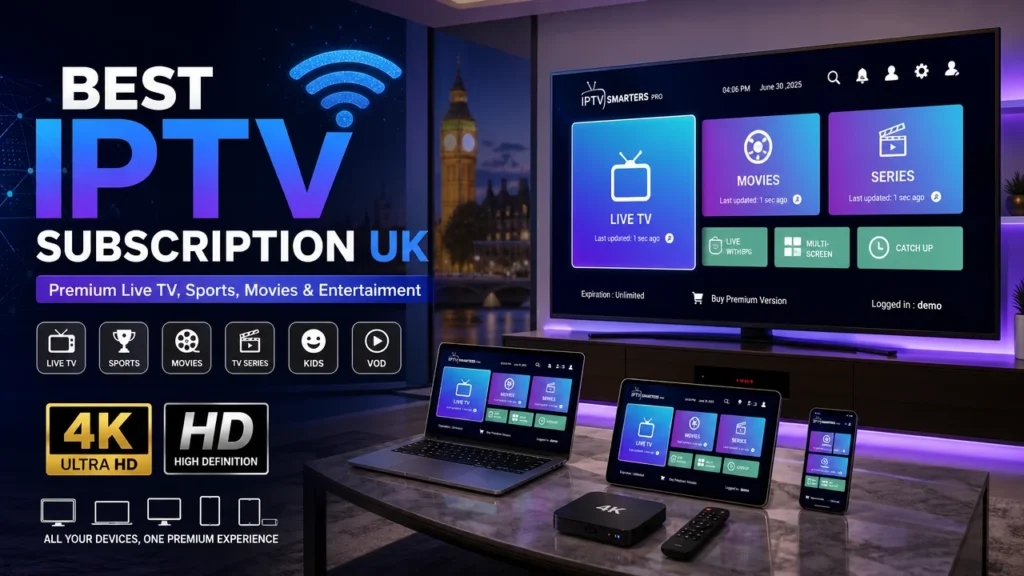
This guide is written for complete beginners. It does not assume you know what M3U, Xtream Codes, or a VPN are, and it only mentions those things where they actually matter. What you get instead is a step-by-step path that ends with a working setup — plus a clear idea of what "reliable" should look like before you hand over any payment. The home screen shown at the top of this article is a typical example of what you will see once the service is running: a live TV grid, a search bar, and a sports shortcut.
One thing matters more than every technical step combined: legality. An ip-tv provider is only worth your time if it operates with the right to distribute the channels it sells. Authorized services usually have a published company name, a support contact, and transparent terms. Grey-market providers often mirror live streams without permission, which is why their prices look impossibly cheap. If you want to know where to buy ip-tv legally, look for a provider that states its licensing situation openly or resells regulated national broadcasters. That distinction is the foundation of everything that follows.
What you will accomplish by the end
By the end of this guide you will have:
- Chosen a legal provider that matches your viewing habits and budget — not merely the most aggressively advertised one.
- Completed a short-term signup, so you have not committed twelve months of money to an unknown service.
- Installed the app on your main device and confirmed that live channels open correctly.
- Adjusted the stream settings that prevent buffering and pixelation during peak evening hours.
That is what a quick start should mean: a handful of decisions, made in the right order, each with a verification step attached.
What you need before starting
You do not need prior experience with internet-based TV. You do need four things:
- A broadband connection with at least 25 Mbps download. That is the realistic floor for a stable HD stream; for 4K live events, aim for 50 Mbps or more.
- A compatible device: smart TV (Samsung, LG, Sony, Philips), Amazon Fire TV Stick, Apple TV, Android TV box, or a phone/tablet. Most providers support at least three of these.
- An email address you check regularly — login details and payment receipts go there.
- A payment method. Major cards, PayPal, or prepaid vouchers are normal. If the only option is cryptocurrency and there is no public support channel, treat that as a red flag.
The table below shows how the most common devices compare for IPTV use.
| Device | Setup difficulty | Best for | Watch out for |
|---|---|---|---|
| Smart TV (Samsung / LG / Sony) | Easy | Living-room viewing, shared household | TVs from around 2018 may stop receiving app updates |
| Amazon Fire TV Stick | Very easy | Most households; cheap and portable | Home screen ads; limited storage for large apps |
| Android TV / Google TV box | Moderate | Enthusiasts who test multiple apps | Sideloading requires enabling unknown sources |
| Apple TV | Easy | Households already in the Apple ecosystem | Fewer niche IPTV apps pass Apple's review process |
| Phone / tablet | Easiest | Travel, quick catch-up, testing before buying | Small screen; battery drains noticeably on live TV |
Step 1: Choose a legal and reliable ip-tv provider
This step takes the longest, and it prevents every later problem. Work through these five checks before you spend anything:
- Confirm the legal basis. The provider should distribute content with rights — either it owns the rights, holds a reseller agreement, or operates under a recognized broadcaster. If the service refuses to state where its streams come from, move on.
- Verify contact and support. A published email, live chat, or ticket system is the basic sign of a functioning business. If the only help option is a personal WhatsApp number, you are buying a gamble, not a service.
- Check the channel list against what you actually watch. If you are looking for an ip-tv provider for sports, confirm that the package carries the specific leagues and competitions you follow. Mid-tier packages usually include major football, basketball, and motorsport; niche sports are the first to disappear when channel line-ups change.
- Look for a free trial or a one-month plan. A legitimate provider can survive a week-long test. Long-term contracts at signup are not normal in this category unless you are buying through a licensed reseller.
- Read honest reviews, including the negative ones. Users who post ip-tv provider reviews on Reddit consistently emphasize two things: test a short plan first, and read the critical reviews rather than the five-star ones. Recent threads reveal outages, support delays, and channel dropouts faster than any promotional copy.
This is the core of how to choose an ip-tv provider: legality first, then channels, then price. The best ip-tv provider 2026 for you is not the one with the largest channel count — it is the one that matches your price, your devices, and your must-have channels. And the single most common mistake beginners make is paying for a long subscription before they have tested the service on their own connection.
The single most common mistake beginners make is paying for a long subscription before they have tested the service on their own connection.
The trade-offs at a glance
| What you gain | What to watch for |
|---|---|
| No cable box rental, no long contract, no installation visit | A provider is only as stable as your broadband connection |
| One plan works across phone, TV, laptop, and tablet | Legality varies between providers; grey-market services can vanish overnight |
| Sports bundles often cost less than satellite sports packages | Support quality differs dramatically from one company to the next |
| Catch-up TV, recordings, and multi-screen viewing in most apps | Live television stops completely if your internet goes down |
Live sports is the most popular reason people switch to an ip-tv provider — and the toughest test any service has to pass. A single match stream pushes both your connection and the provider's servers to their limit, which is why the short trial matters so much. The photo below shows a typical setup for exactly that use: a live match on a laptop, away from the main television.
Step 2: Sign up and pick the right plan
Once you have shortlisted a candidate, signup is routine. Do it in this order:
- Go directly to the provider's official website. Do not click ads that claim to be the provider — some are unauthorized resellers charging a markup for the same service.
- Create an account with your email address.
- Choose a one-month plan or free trial, even if the annual plan looks dramatically cheaper. This is the cheapest ip-tv subscription that still gives you useful information: a full month includes several weekdays and a weekend, so you can judge real-world stability.
- Pay with a method you can trace — card, PayPal, or a recognized voucher.
- Save your login details in a password manager and note the renewal date.
Common mistakes at this stage
- Paying for a year up front. A provider can change its line-up, disappear, or simply disappoint. Keep the test short.
- Buying the biggest bundle out of habit. Basic single-screen plans cost far less, and most households rarely watch more than two screens at once.
- Ignoring the connection requirement. If your broadband sits under 25 Mbps, no provider will feel reliable. Lower the stream quality to 720p and watch on one screen rather than paying for a package that assumes faster internet.
Step 3: Install the app and log in
Installation varies by device, but the principle is the same: install the app, sign in, open a channel.
- Smart TV (Samsung Tizen, LG webOS, Sony Google TV): search the TV's app store for the provider name. If it is absent, most providers publish a USB sideload guide on their official page — follow that, and only that.
- Amazon Fire TV Stick: search the Amazon App Store first; most providers publish there. If the app is not listed, install the Downloader app from the store, enable "unknown sources", and enter the short URL from the provider's guide.
- Android phone or tablet: download the APK from the official site and enable "Install unknown apps" for your browser. Open the file, install, and sign in.
- Apple TV and iOS: Apple's review rules keep many IPTV apps out of its store. Check the App Store first, then follow the provider's published instructions exactly.
Three optimization tips to apply now
- Use a wired connection where possible. An Ethernet cable eliminates Wi-Fi interference, and that alone fixes most buffering complaints.
- Set the buffer size to its maximum in the app's player settings. VLC users can set it to 3000 ms; other players offer a similar "large buffer" option. It uses a little more memory and absorbs short network dips.
- Leave the default quality at 1080p before touching 4K. Selecting 4K on a 25 Mbps connection causes constant rebuffering. Scale up only after you have confirmed stability during a live broadcast.
Step 4: Optimize quality, test, and finalize
With the app installed, the final step makes sure the service stays watchable:
- Test at prime time. Watch a live channel at 20:00 or during a major game — that is when networks are most congested. No buffering for 15 minutes means the provider passes.
- Verify the EPG. The programme guide should match what is actually airing. If a channel's guide is empty, refresh it inside the app.
- Test catch-up and recording if you plan to use them. Record a few minutes and confirm the clip is stored where you expect.
- Set a reminder for the renewal date. Month-to-month plans roll over automatically; the calendar note is your only protection against unwanted charges.
- Enable app auto-updates where your platform allows it. Providers update channel lists regularly, and an updated app is the simplest way to fix dead channels.
A reliable ip-tv provider with no buffering is rarely a miracle. It is the predictable result of testing the service on your own connection, at the right time of day, before committing a larger amount of money.
Troubleshooting if something goes wrong
- Buffering every few seconds: lower the stream quality to 720p first. Restart the router, disconnect unused devices, and try an Ethernet cable. Buffering usually has a network cause, not a provider cause.
- Channel list empty: restart the app to refresh the channel list. Providers often deliver it as an M3U playlist or Xtream code that expires; re-login if the refresh does not help.
- Login fails: check for a trailing space in the password, confirm Caps Lock is off, and verify the subscription has not expired. Check spam for the verification email.
- Sound but no picture: usually a codec issue on the device. Set the player output to "PCM" or disable hardware decoding in the app settings.
- Picture but no sound: on Fire TV and Android boxes, toggle off "audio passthrough". Some channels broadcast an audio format the television cannot decode while that setting is enabled.
- A VPN blocks all channels: some providers restrict data-center IP addresses. Use a residential server if you need a VPN for privacy, or choose a provider that states VPN support openly.
Where to Buy
Compare package options and check what the current offer includes before you decide.
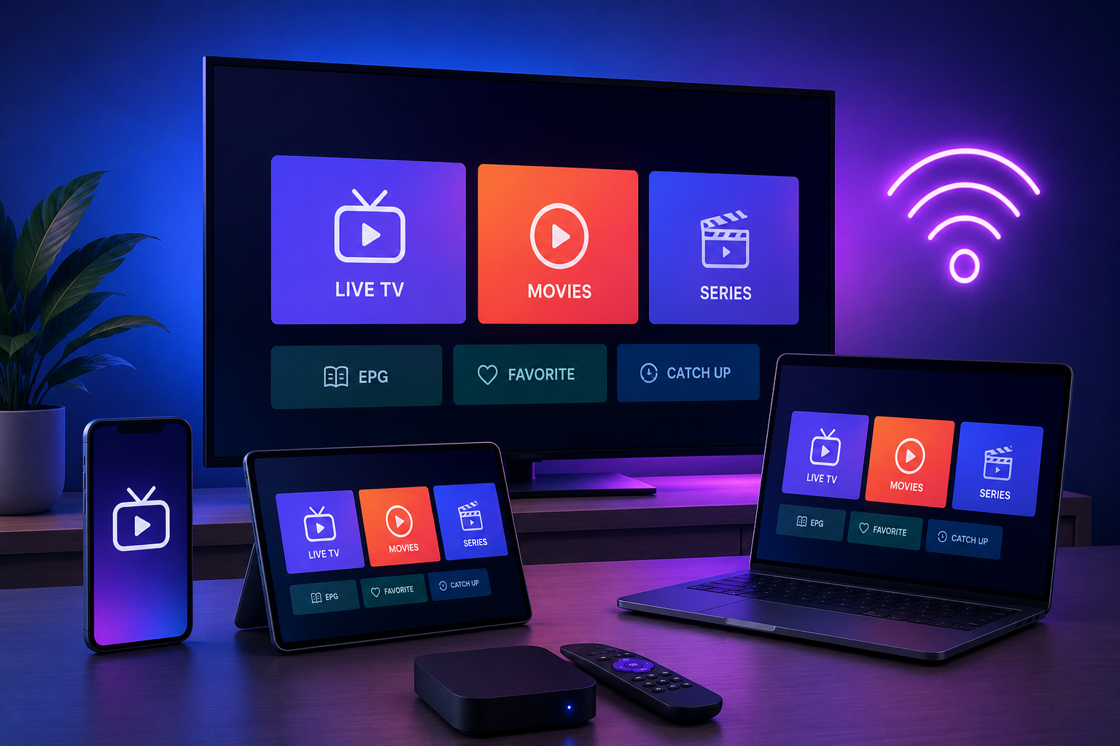
Most households soon discover that the real value of an ip-tv provider is being able to watch the same subscription on more than one screen. The photo below shows that reality: one account, open at the same time on a phone, a tablet, and a television.
All setup steps at a glance
| Step | What to do | Time | How to verify |
|---|---|---|---|
| 1 | Choose a legal provider with a short-term plan | 15–20 min | Company identity and contact published on its site |
| 2 | Sign up with email and pay for one month | 5 min | Confirmation email received |
| 3 | Install the app and sign in | 10 min | A live channel opens within a few seconds |
| 4 | Test at prime time and optimize settings | 10 min | 15 minutes of viewing with no buffering at 20:00 |
A provider worth starting with
If you would rather skip the research spiral, ip-tv provider is among the most visible services in this category, with published setup guides for the main platforms and short-term plan options. Use the same discipline from this guide: treat the first month as your test, verify prime-time stability, and decide after that.
If you prefer to compare the market first, the framework above — legality, support, channel list, short-term plan, honest reviews — applies to every provider you find. The method matters more than the name.
The Bottom Line
An ip-tv provider is the right choice if you want live channels and on-demand content across the devices you already own, without cable hardware or long contracts. The strongest reason to go with a verified provider is the ability to test a short plan first, which keeps the whole decision small and reversible.
Main OfferThis link goes to the seller's official checkout. If you purchase through it, we may earn a commission at no additional cost to you. Our assessment is written independently of that arrangement.
Frequently Asked Questions
What is an ip-tv provider and is it legal?
An ip-tv provider delivers live television channels and on-demand video through your internet connection instead of a cable line or satellite dish. Legality depends entirely on the provider: a legitimate service holds copyright licensing or reseller agreements for the content it carries, while grey-market providers stream without permission. Check for a published company identity, terms of service, and a support contact. If those are missing, the service is operating outside legal distribution channels and you should not give it your payment details.
How do I choose the best ip-tv provider 2026?
Choose based on five criteria: legal status, device compatibility, a channel list that matches what you watch, a free trial or one-month plan, and verifiable reviews. The best ip-tv provider 2026 for you is the one that scores well on all five at a price you can test month-to-month. Ignore channel counts above 10,000 — nobody watches that many, and inflated numbers are a common sign of resellers aggregating unreliable streams.
Can I use an ip-tv provider for sports without buffering?
Sports is the most demanding use case because live events are watched by thousands simultaneously and bitrates climb in 4K. To avoid buffering, you need a connection of at least 25 Mbps for 1080p and 50 Mbps for 4K, plus an Ethernet cable if the device is near the router. Even then, no provider is completely immune to hiccups during major finals, since the bottleneck is often last-mile network congestion. Test the service during a live match before committing to a longer subscription.
What is the cheapest ip-tv subscription that still works well?
The cheapest ip-tv subscription worth your money is a one-month plan that lets you test properly, typically $10 to $15 or the equivalent in your market. A free trial is cheaper still, but two or three days is rarely enough to judge stability during peak evening hours. Avoid anything that requires paying a year in advance — that is not "cheap," it is a way to make a broken service sound attractively priced. The best value is a short test that gives you real information.
Are there reliable ip-tv providers on Reddit I can trust?
Reddit threads can be useful because they are timestamped and searchable, but approach them with care. Forums that discuss IPTV often receive posts from resellers promoting their own services. Look for users who describe specific problems — outage dates, support response times, actual connection speeds — rather than two-line praise. Search for the provider name plus "buffering" or "issues" to see the negative side, then test that provider on a short plan yourself.
Where can I buy ip-tv legally in the US, UK, or EU?
In the US, UK, and EU, the legal routes are licensed services and resellers that hold distribution agreements from broadcasters. A legitimate reseller will state this on its website. If a service markets itself only through anonymous social media profiles and prices far below conventional services, it is almost certainly not licensed. Ask the provider directly where it obtains distribution rights and what happens if a channel is pulled — a legal operator will be able to answer in writing.
How do I set up an ip-tv provider on Fire TV Stick?
On Fire TV Stick, search the Amazon App Store for the provider's app first; if it is available, install and log in. If it is not there, install the Downloader app from the store, go to the provider's official setup guide for the short URL, then allow "unknown sources" as instructed. After the APK downloads, open it and log in with your credentials. Finish with the prime-time test from Step 4 to confirm stability on your connection.
Is iptv service better than cable tv?
IPTV and cable TV solve the same problem in different ways. A legal iptv service gives you device flexibility, no set-top box rental, and month-to-month pricing, while cable offers a familiar one-install setup and a straightforward support route. For most households with broadband above 25 Mbps, IPTV offers better value; if you prefer not to manage apps and connections yourself, cable remains the low-effort option.
Disclosure: Some links in this article are affiliate links, meaning we may earn a commission if you make a purchase — at no additional cost to you. This does not influence our editorial assessment, which is based on publicly available information about the product.