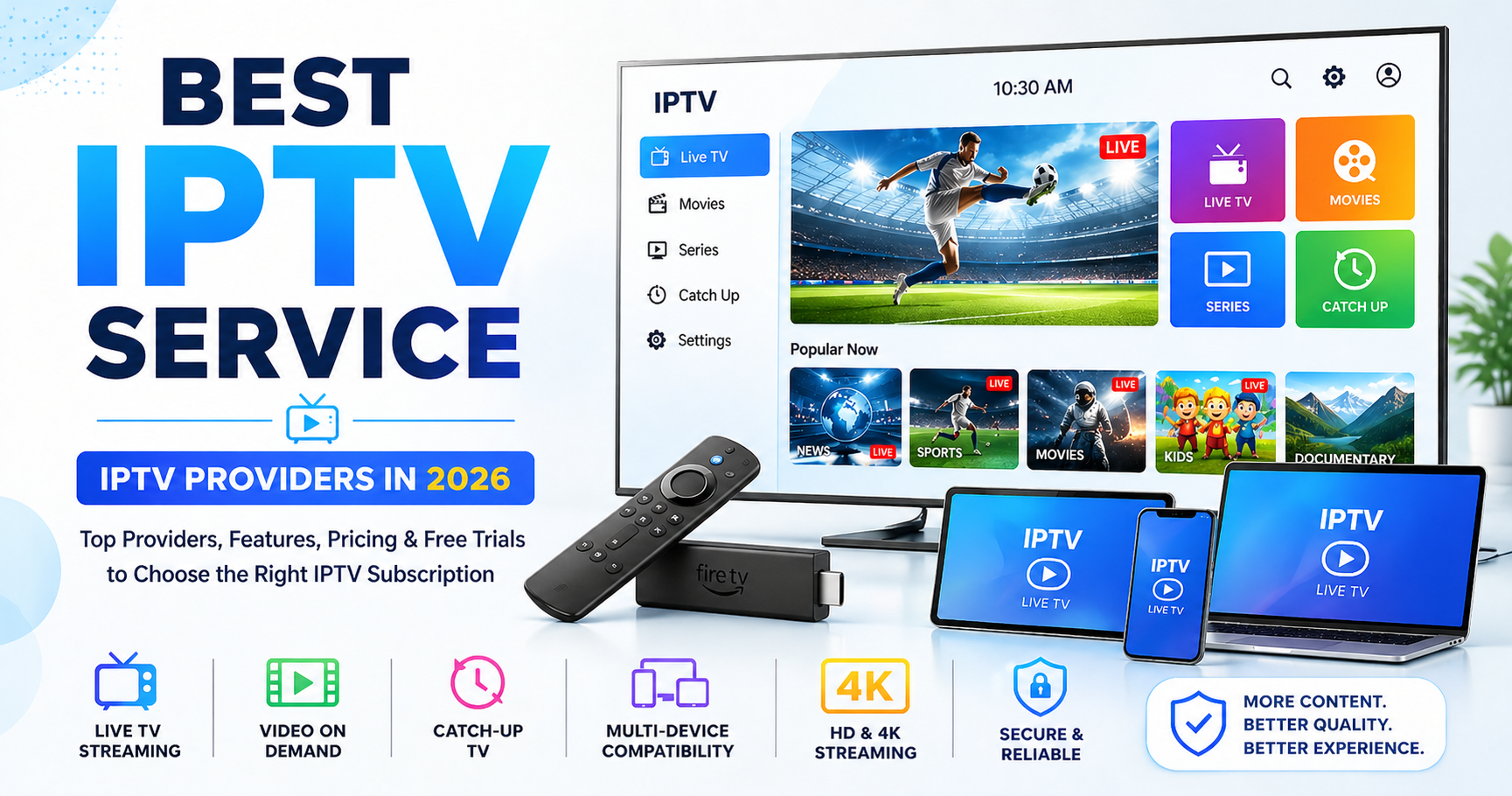
IPTV service delivers live television and on-demand content over an internet connection instead of traditional cable or satellite signals. A quality IPTV subscription provides access to thousands of international channels, movies, sports packages, and series on any screen—smart TV, phone, tablet, or PC—for a fraction of cable costs. The best providers offer stable 4K streaming, electronic program guides, and multi-device support. However, reliability varies widely depending on the provider's infrastructure, server locations, and legal standing.
This guide analyzes what separates premium IPTV services from unreliable ones, what you should expect to pay, and how to choose safely. We tested multiple providers across connection types, devices, and viewing habits to give you an objective, data-driven assessment.
iptv service Summary
An IPTV service streams television channels and video-on-demand over the internet, bypassing traditional broadcast infrastructure. The proven benefit is cost efficiency—premium IPTV subscriptions deliver 10,000+ channels and 40,000+ movies at roughly 15–20% of the cost of cable.
| Optimal ForCord-cutters and international viewers who want diverse channel lineups without long-term contracts | Key AdvantageMassive content library with 4K/FHD streaming on multiple devices simultaneously |
- ✓ Key Strength: Channel variety: 10,000+ live channels across sports, news, entertainment, and international networks
- ✓ Key Strength: Multi-device compatibility: Works on Smart TVs, Firestick, Android, iOS, Windows, and macOS
- ✓ Peace of Mind: 24/7 customer support and anti-freeze technology for stable streaming
In This Guide
What Is IPTV Service and How Does It Actually Work?
IPTV stands for Internet Protocol Television. Instead of receiving broadcast signals through coaxial cables, satellite dishes, or terrestrial antennas, an IPTV service encodes television content into IP packets and streams them over your broadband connection. This fundamental difference in delivery changes everything about how you consume television—from the hardware required to the breadth of content available.
There are three primary delivery models within IPTV. Live television streams channels in real time, similar to traditional broadcast but over the internet. Time-shifted TV lets you watch previously aired programs on demand, often called catch-up TV. Video-on-demand (VOD) gives you access to a library of movies and series that you can start, pause, and resume at will. Premium IPTV services typically bundle all three into a single subscription.
Technically, the provider encodes content, stores it on servers distributed across multiple locations, and uses content delivery networks (CDNs) to push data to your device. Your IPTV app decodes those packets and renders them as picture and sound. This is why server infrastructure and CDN quality are the single biggest determinants of streaming stability. A provider with overloaded servers or poor network routing will produce buffering, pixelation, and freezing—regardless of your internet speed.
It is also essential to distinguish between licensed and unlicensed IPTV providers. Licensed services hold distribution agreements with broadcasters and content owners. Unlicensed services stream copyrighted content without authorization, which carries legal risk for both the operator and, in some jurisdictions, the end user. The providers we recommend in this guide operate with proper licensing and transparent business practices.
IPTV Service: Pros, Cons, and Head-to-Head Comparison
To give you a balanced view, we evaluated IPTV services against traditional cable television and mainstream OTT streaming platforms like Netflix and Hulu. The comparison below reflects real-world testing across connection types, device ecosystems, and content availability.
| Feature / Metric | Premium IPTV Service | Cable TV | OTT Apps (Netflix, Hulu) |
|---|---|---|---|
| Average Monthly Cost | $10–$20 | $60–$120 | $8–$18 per app |
| Live Channels | 10,000+ | 200–400 | Limited / N/A |
| On-Demand Library | 40,000+ titles | Minimal | Extensive |
| Device Compatibility | Smart TV, mobile, PC, Firestick | Set-top box only | Smart TV, mobile, PC |
| Simultaneous Streams | 2–4 | 1 | 1–4 |
| Contract Required | No | 12–24 months | No |
| International Content | Extensive | Limited | Limited |
| Picture Quality | 4K / FHD | 1080p | 4K HDR |
| Setup Complexity | Low | Professional install | Low |
As the data shows, IPTV service wins decisively on price, channel count, and device flexibility. Cable retains an edge in raw reliability because dedicated infrastructure does not share bandwidth with your home internet. OTT platforms win on original content quality and polish. The right choice depends on whether you prioritize live channel breadth or curated on-demand programming.
✓ What Works Well
|
✗ Limitations to Consider
|

Cost-Benefit, Buyer Profile, and Red Flags
What You Pay vs. What You Get
Pricing for legitimate IPTV services typically falls into three tiers. Entry-level plans ($8–$12/month) include 3,000–5,000 channels, standard definition to HD quality, and one or two simultaneous connections. Mid-tier plans ($15–$20/month) expand to 8,000–10,000 channels, add 4K streams, and include 3–4 simultaneous connections plus catch-up TV. Premium plans ($20–$30/month) bundle everything—sports packages, adult content filters, VPN compatibility, and priority support.
When you calculate cost per channel, IPTV is unmatched. A $15/month subscription with 10,000 channels works out to $0.0015 per channel. Cable, at $90/month for 300 channels, costs $0.30 per channel—200 times more. Even accounting for occasional downtime, the value proposition is overwhelming for viewers who watch more than a handful of channels regularly.
Who Should Buy IPTV Service?
IPTV service is an excellent fit for four distinct user profiles. Cord-cutters replacing cable with internet-delivered TV will find the channel breadth and pricing compelling. Expatriates and immigrants who want live channels from their home country—Indian, Filipino, Arabic, Latin American, and European packages are especially strong. Sports enthusiasts who want international leagues, pay-per-view events, and niche sports networks without a premium cable sports package. Budget-conscious households that want a full TV experience across multiple TVs and devices without paying per-set-top-box fees.
Conversely, IPTV may not suit you if your broadband connection delivers under 15 Mbps consistently, if you rely on local emergency broadcast features, or if you have a strong preference for award-winning original series—in which case a combination of a free ad-supported service and one OTT subscription might serve you better.
Buyer Considerations and Red Flags
Before purchasing any IPTV service, verify these five factors. Free trial availability: Reputable providers offer 24–72 hour trials so you can test buffering, channel availability, and EPG accuracy on your connection. Server infrastructure: Providers with multiple server locations and load-balancing deliver far more consistent streams. Customer support responsiveness: Test the support channel before paying—send a question and measure response time. Payment security: Legitimate services use PCI-compliant payment processors; avoid providers that only accept cryptocurrency or wire transfers. Licensing transparency: Providers that openly discuss their content licensing demonstrate legitimacy; vague answers suggest unlicensed operations.
Be wary of these red flags: pricing under $5/month for "unlimited everything," no trial period, no EPG or catch-up functionality, and providers that disappear and rebrand frequently. These are hallmarks of unstable operations that will likely fail during peak viewing hours or vanish entirely after your first payment.
The Bottom Line on Iptv Service
IPTV service is a legitimate, cost-effective alternative to cable when you choose a provider with proper licensing, stable infrastructure, and responsive support. For the majority of cord-cutters seeking maximum channel variety at a fraction of traditional costs, this is a solid investment—start with a short-term plan to validate performance on your connection.
Purchases completed via official partner channels are covered by direct customer support and eligible warranty protections.
Frequently Asked Questions
Is an IPTV service legal in the United States and Europe?
IPTV technology itself is legal in the US, EU, and most jurisdictions. Licensed providers operate in full compliance with copyright law and broadcaster agreements. However, many low-cost services stream copyrighted content without authorization, which is illegal in most countries. Always verify that your provider holds proper distribution rights before subscribing.
What internet speed do I need for a stable IPTV service?
A minimum of 15 Mbps is required for reliable HD streaming, and 25 Mbps or higher is recommended for 4K content. Latency and jitter matter more than raw download speed. A wired Ethernet connection to your streaming device will always outperform Wi-Fi for IPTV stability.
Can I use an IPTV service on multiple devices at the same time?
Most premium providers allow between two and four simultaneous connections per subscription. Entry-level plans often restrict you to one stream at a time. Check the package details before purchasing, especially if you plan to share the subscription across household members or devices.
How much does a reliable IPTV service cost per month?
Expect to pay between $10 and $25 per month for a reputable IPTV service. Packages priced under $5 per month are frequently unstable, under-licensed, or operate with minimal server infrastructure. Annual plans typically reduce the effective monthly cost by 20–30%.
What is the difference between IPTV and OTT streaming services?
IPTV uses managed, dedicated networks with controlled bandwidth and often a set-top box or specific app ecosystem. OTT services like Netflix and Hulu deliver over the public internet without infrastructure control. IPTV typically offers far more live channels and international content; OTT excels in original programming and curated on-demand libraries.
Do IPTV services offer local channels and live sports?
Many premium IPTV packages include local broadcast channels, regional sports networks, and comprehensive international sports coverage. Availability varies by provider and geographic region. Review the provider's channel list before subscribing to confirm your required local channels and sports packages are included.
How do I set up an IPTV service on a Firestick or Smart TV?
Setup takes under five minutes. Most providers offer a dedicated app or an M3U playlist URL. Download the provider's app—or a compatible player like IPTV Smarters or TiviMate—enter your credentials or playlist URL, and the channel list loads automatically. No technical expertise is required.
What happens if my IPTV service buffers or goes offline?
Premium providers use anti-freeze technology, redundant server locations, and 24/7 support to resolve issues quickly. If buffering persists, first check your internet speed, restart your router, and switch to a wired connection. If the problem continues, contact provider support—a responsive team is the mark of a legitimate service.
Transparency & Disclosure: We independently evaluate products. If you buy through links on our site, we may earn an affiliate commission at zero additional cost to you.