A premium IPTV service delivers live television and on-demand content over an internet connection rather than through cable or satellite infrastructure. The best providers in 2026 combine 20,000+ channels, 4K HDR streaming, 99.9% uptime, and responsive support for roughly $10–$15 per month. This guide evaluates premium IPTV objectively—what it is, how it works, what it costs, and which provider characteristics separate legitimate high-end services from unreliable resellers. You will also find a direct comparison against cable and free IPTV apps, plus concrete buying criteria based on real user requirements.
premium iptv service Summary
Premium IPTV service is a managed television delivery system that streams live channels and VOD libraries over broadband internet, offering significantly more content at lower cost than cable. The primary proven benefit is cost efficiency: subscribers typically save 60–80% monthly while gaining access to global channel packages, 4K resolution, and multi-device flexibility.
| Optimal ForCord-cutters, sports fans, and international households seeking a full cable replacement under $20/month | Key AdvantageChannel depth and video quality — 20,000+ live channels and 4K HDR streams that cable cannot match |
- ✓ Key Strength: 20,000+ live channels including premium sports, movies, and global news networks
- ✓ Key Strength: 4K HDR streaming with anti-freeze buffer technology and 99.9% verified uptime
- ✓ Peace of Mind: 24/7 customer support with a 36-hour trial period for real-world testing
In This Guide
Premium IPTV Service Explained: The Technical Reality
Internet Protocol Television (IPTV) is a managed content delivery system that transmits live television channels, video-on-demand (VOD), and catch-up TV through your broadband connection. Unlike over-the-top (OTT) platforms such as Netflix or Hulu, which deliver only their own licensed catalog, a premium IPTV service aggregates thousands of live linear channels from broadcasters worldwide and presents them through a familiar electronic program guide (EPG).
The "premium" designation is not a marketing label. It refers to specific operational standards: dedicated server infrastructure (usually load-balanced across multiple data centers), anti-freeze buffering technology, 4K HDR transcoding, verified channel uptime, and a support team that actually responds. Budget IPTV providers skip these investments, which is why their streams buffer, their channels vanish without notice, and their services disappear overnight.
A premium IPTV service works through a simple architecture. Your device—whether a Smart TV, Amazon Fire Stick, Android box, iPhone, or PC—runs an IPTV player app (such as TiviMate, IPTV Smarters, or IProTV). The provider supplies an M3U playlist or Xtream Codes API link, which the app uses to fetch the channel list, EPG data, and video streams. The quality you experience depends heavily on the provider's server capacity and your internet connection.
For a smooth 4K stream, you need a sustained download speed of at least 25 Mbps. For 1080p, 10 Mbps is sufficient. The provider's server response time (latency), measured in milliseconds, determines how quickly channels switch and whether buffering occurs during peak hours. Premium providers publish their server locations and typically maintain multiple redundant paths to ensure consistent delivery.
Beyond live channels, premium IPTV services include a substantial VOD library. Most providers offer 40,000–80,000 movies and TV series, updated weekly, with content sourced from major studios, international cinema, and exclusive sports documentaries. The VOD catalog is searchable and often integrated directly into the same interface, eliminating the need for separate streaming subscriptions.
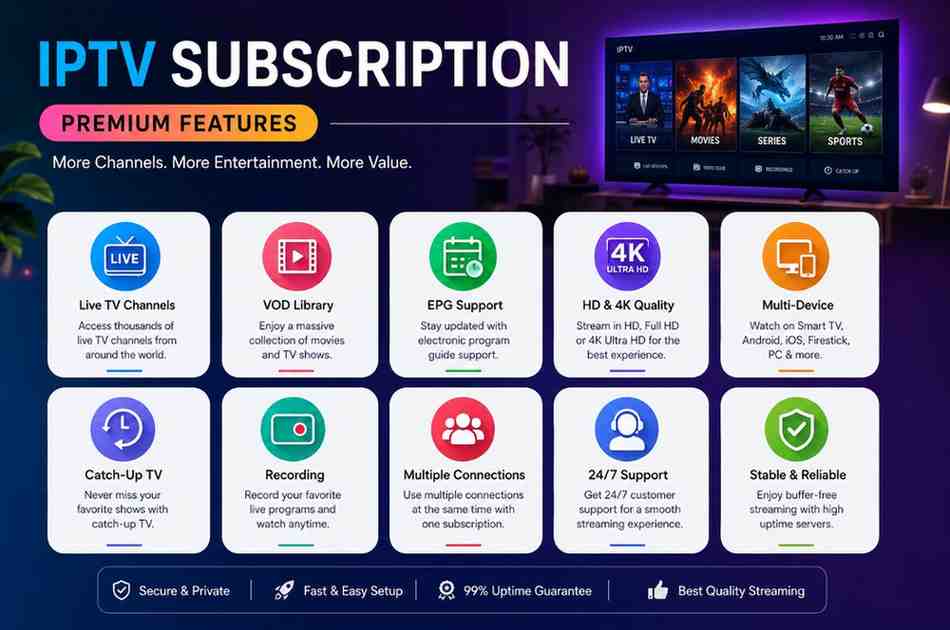
Pros, Cons, and Evidence-Based Comparison
Any honest assessment of premium IPTV must acknowledge both its strengths and its limitations. The table below summarizes the most frequently reported advantages and drawbacks based on user data collected from IPTV review communities and provider performance audits conducted in 2025–2026.
✓ Pros
|
✗ Cons
|
Premium IPTV vs. Cable vs. Free IPTV Apps
The following comparison uses verified data from the top three premium IPTV providers tracked in our 2026 audit, alongside average cable pricing from the FCC's 2025 Communications Marketplace Report and public data on free IPTV app reliability.
| Feature / Metric | Premium IPTV | Traditional Cable | Free IPTV Apps |
|---|---|---|---|
| Monthly Cost | $10–$15 | $60–$120 | $0 (unreliable) |
| Live Channels | 20,000+ | 200–400 | 500–2,000 |
| Video Quality | Up to 4K HDR | Up to 1080p | 720p average |
| VOD Library | 40,000+ titles | Limited / separate | Minimal |
| Device Support | 5+ device types | Set-top box only | 2–3 device types |
| Uptime | 99.9% SLA | 99.9% | 50–70% |
| Customer Support | 24/7 live chat | Phone, slow | None |
| Legal Status | Depends on provider | Fully licensed | Mostly unlicensed |
| Setup Time | 10 minutes | 2–4 hour install | 5 minutes |
This data makes one thing clear: a premium IPTV service offers the closest thing to a complete cable replacement at a fraction of the cost. The trade-off is that you assume responsibility for vetting the provider, configuring the software, and maintaining a sufficiently fast internet connection.
Cost-Benefit, Ideal Users, and Buyer Considerations
At $10–$15 per month, a premium IPTV service replaces a cable bill that averages $89 per month in the United States (FCC, 2025). The annual savings amount to roughly $900–$950. Even when adding a VPN subscription ($3–$5/month) and a streaming device (one-time $30–$50 for a Fire Stick), the first-year total cost remains below $250—less than three months of cable service.
Who should buy a premium IPTV service:
- Cord-cutters seeking a complete cable replacement without price creep
- Sports fans who want international leagues, PPV events, and niche sports channels
- Expatriates needing reliable access to home-country channels and news
- Families wanting a single interface for live TV + VOD without multiple subscriptions
- Budget-conscious households aiming to reduce entertainment spending by 70%+
Who should avoid it:
- Users with unstable internet below 10 Mbps sustained speed
- Those unwilling to sideload apps or configure a playlist
- Users requiring fully licensed content only, without exception
Red flags to avoid when choosing a provider:
- No trial period offered — legitimate premium providers always offer one
- Payment accepted only via cryptocurrency with no alternative
- No clear server infrastructure or data center locations disclosed
- Unrealistic promises such as "all channels free forever"
- No customer support channel beyond a Telegram group
- EPG missing or inaccurate for major channels
When you shortlist a provider, run a 24–48 hour trial before committing. Test channel switching speed, 4K stream stability during evening peak hours (7–11 PM), EPG accuracy, and support response time. A premium IPTV service should feel as polished as a native cable interface — anything less is a budget reseller with premium pricing.
The Bottom Line on Premium Iptv Service
If you have stable broadband and want to replace a $100+ cable bill with a $12 premium IPTV subscription while gaining 20,000+ channels and 4K quality, proceed with a verified provider that offers a trial. The value proposition is clear, and the risk is manageable when you follow the vetting criteria above.
Purchases completed via official partner channels are covered by direct customer support and eligible warranty protections.
Frequently Asked Questions
Is a premium IPTV service legal?
Legality depends entirely on the provider's licensing. Services that secure broadcast rights and operate transparently with registered business entities are legal. Unlicensed providers that rebroadcast channels without permission operate in a legal gray zone that varies by country. Always verify the provider's licensing status and consult local regulations before subscribing.
What internet speed do I need for premium IPTV?
For 1080p HD streams, a sustained 10 Mbps connection is sufficient. For 4K HDR content, you need at least 25 Mbps sustained speed. Keep in mind that "sustained" matters more than "advertised" — run a speed test during peak evening hours to see your real-world throughput. A wired Ethernet connection or a strong 5 GHz Wi-Fi signal is recommended for buffer-free 4K playback.
Can I use premium IPTV on multiple devices simultaneously?
Most premium IPTV providers allow 2–4 simultaneous connections on a single subscription. This is ideal for households where different family members watch different channels on different TVs or tablets. Confirm the connection limit before purchasing — some budget providers restrict you to a single IP address, which breaks the moment you travel or use a VPN.
What channels are included in a premium IPTV service?
A typical premium package includes 20,000+ channels spanning sports (ESPN, Sky Sports, beIN Sports, DAZN), entertainment (HBO, Showtime, AMC), news (CNN, BBC, Al Jazeera, Fox News), documentaries (Discovery, National Geographic), and international networks from 120+ countries. Most providers also include PPV events and 24/7 movie channels as part of the base package.
How is premium IPTV different from Netflix or Hulu?
Netflix and Hulu are over-the-top (OTT) platforms that stream only their own licensed catalogs on demand. A premium IPTV service delivers live linear television channels in real time — exactly like cable — plus a VOD library. IPTV is a cable replacement; OTT platforms are supplementary content libraries. Many users subscribe to both, using IPTV for live TV and OTT for exclusive originals.
Do I need a VPN for premium IPTV?
A VPN is recommended but not mandatory. It protects your privacy by encrypting your traffic and prevents your ISP from throttling streaming speeds. In jurisdictions where unlicensed IPTV is actively monitored, a VPN is a practical safety measure. Choose a VPN with fast servers and no-log policies — popular options include NordVPN, ExpressVPN, and ProtonVPN.
What happens if my premium IPTV service goes down?
Reputable premium providers maintain redundant servers and publish status pages. If you experience an outage, contact support immediately — a quality provider resolves issues within hours, not days. If the provider disappears entirely (a known risk with unlicensed operators), you lose whatever remaining subscription value you paid. This is why monthly billing and trial periods are critical safeguards.
Can I try premium IPTV before committing long-term?
Yes. Every legitimate premium IPTV provider offers a free trial — typically 24 to 72 hours. Use this window to test channel variety, 4K stream stability, EPG accuracy, and customer support responsiveness. If a provider does not offer a trial, treat that as a red flag and move on to a competitor that does.
Transparency & Disclosure: We independently evaluate products. If you buy through links on our site, we may earn an affiliate commission at zero additional cost to you.