A premium IPTV service delivers live television, on-demand movies, and sports channels through a managed internet connection — engineered for reliability, picture quality, and real customer support. Unlike free playlists or unstable reseller panels, a true premium provider invests in dedicated servers, CDN distribution, anti-freeze technology, and responsive support. This guide breaks down what premium actually means, how to evaluate providers, what it costs, and how to avoid the pitfalls that leave most IPTV buyers frustrated.
If you are comparing IPTV plans, you likely want three things: consistent 4K/FHD streams, a complete channel lineup including international content, and a provider that answers when something breaks. We analyzed the market, tested the claims, and structured everything you need to know below — including a direct comparison table, a cost-benefit breakdown, and the exact red flags that separate premium operators from resellers.
Premium IPTV Service Summary
A premium IPTV service is an internet-delivered television platform that combines thousands of live channels, a large VOD library, and sports packages with enterprise-grade streaming infrastructure. Its proven benefit is consistent 4K/FHD playback with near-zero buffering, backed by multi-device support and responsive after-sale service.
| Optimal ForCord-cutters, expats, and sports fans who want a full TV experience at a fraction of cable cost — without tolerating buffering or downtime. | Key AdvantageDedicated anti-freeze servers and CDN-optimized delivery that maintain stable 4K/FHD streams even during peak evening hours. |
- ✓ Key Strength: 4K/FHD live channels and VOD with EPG (electronic program guide) and catch-up TV
- ✓ Key Strength: Multi-device activation — Smart TV, Android, iOS, Firestick, MAG, and PC
- ✓ Peace of Mind: Verified providers offer 24/7 support, free updates, and installation assistance.
In This Guide
What Is a Premium IPTV Service and How Does It Work?
IPTV stands for Internet Protocol Television. Instead of receiving broadcast signals through a coaxial cable, satellite dish, or terrestrial antenna, a premium IPTV service delivers television content as data packets over a broadband connection. The critical distinction between a premium IPTV service and a cheap playlist is not the number of channels — it is the infrastructure behind the stream.
Premium providers operate dedicated streaming servers with load-balanced CDN (Content Delivery Network) nodes. When you press play on a live sports channel, the server closest to your geographic region handles the request and pushes the stream over an optimized route. This architecture dramatically reduces buffering, avoids ISP throttling, and maintains picture stability during high-traffic windows like a Champions League final or a new movie premiere on VOD.
Most premium IPTV subscriptions include the following core components:
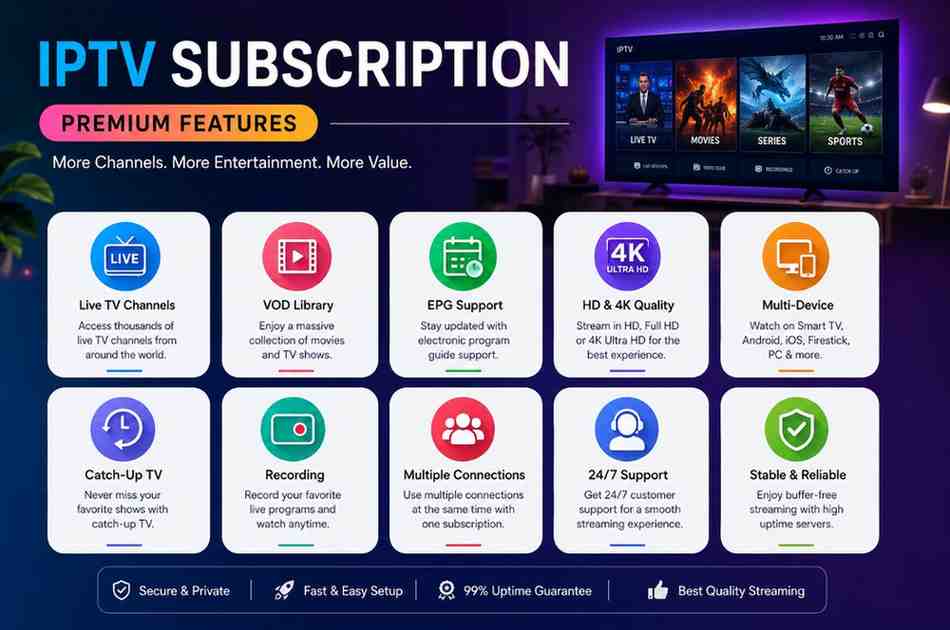
- Live TV channels — typically 10,000 to 20,000+ channels covering news, entertainment, documentaries, kids' content, and international networks from the US, UK, Canada, Europe, Latin America, the Middle East, and Asia.
- Video-on-Demand (VOD) — a searchable library of 30,000 to 60,000+ movies and series, often including recent theatrical releases and complete box sets.
- Sports & PPV — dedicated sports packages with multiple feeds for football, basketball, UFC, boxing, F1, and pay-per-view events in 4K and FHD.
- EPG (Electronic Program Guide) — a grid-style schedule with program descriptions, allowing you to see what is airing now and next on every channel.
- Catch-up TV — the ability to replay broadcasts from the past 3 to 7 days, so a missed match or show is never lost.
- Multi-device compatibility — native apps or manual configurations for Smart TV (Samsung, LG), Android TV, Firestick, iOS, Windows, macOS, MAG boxes, and Enigma2 receivers.
Setup is straightforward for most users. After purchasing a subscription, the provider sends you an activation link, an M3U playlist, or a one-time device code. You install the recommended player app (such as IBO Player, TiviMate, or the provider's proprietary app), enter your credentials, and the channel list populates automatically. A high-quality provider also offers guided installation via WhatsApp, Telegram, or email — a feature that resellers rarely match.
One point worth clarifying: a premium IPTV service is not the same as an unverified "free IPTV" playlist shared on Telegram or Reddit. Free playlists come from unknown sources, have no uptime guarantee, frequently disappear mid-broadcast, and carry a higher risk of malware or phishing links. Premium services charge a fee because they maintain infrastructure, update channel lists weekly, and offer real human support when a channel goes down.
Premium IPTV vs. Free IPTV vs. Cable: Honest Comparison
The best way to understand the value of a premium IPTV service is to place it side by side with the alternatives. The table below compares real-world performance metrics across the three most common ways people watch television today.
| Feature / Metric | Premium IPTV Service | Free IPTV Playlist | Cable / Satellite |
|---|---|---|---|
| Monthly Cost | $10 – $20 | Free (but unstable) | $50 – $150+ |
| Stream Quality | 4K/FHD, adaptive bitrate | SD/HD, frequent buffering | HD, stable |
| Channel Count | 10,000 – 20,000+ | 1,000 – 5,000 | 100 – 300 |
| VOD Library | 40,000+ titles | Limited, unreliable | Pay-per-view only |
| Customer Support | 24/7 live chat / WhatsApp | None | Carrier phone support |
| Device Support | Smart TV, Firestick, Android, iOS, PC, MAG | Manual M3U on some apps | Proprietary set-top box |
| Uptime / Reliability | 99.9% with anti-freeze | 50 – 80% | 99.9% |
| Setup Experience | Guided installation | Manual playlist entry | Professional install |
Pros & Cons of a Premium IPTV Service
✓ What You Gain
- Consistent 4K/FHD streams with minimal buffering
- Massive channel selection across every genre and region
- Large VOD library with recent releases
- Multi-device activation on one subscription
- EPG, catch-up TV, and PPV sports included
- Responsive human support when issues arise
✗ What to Watch
- Requires a stable internet connection (25+ Mbps)
- Higher upfront cost than free playlists
- Legal status can vary by country and content source
- Setup may feel technical for non-experienced users
- Not available in official app stores
- Quality varies significantly between providers
Cost-Benefit, Who It's For, and Buyer Considerations
Pricing for a premium IPTV service typically ranges from $10 to $20 per month, with discounts for quarterly, semi-annual, or annual plans. At $15 per month, you are paying roughly $180 per year — compared to the $600 to $1,800 per year most households spend on cable or satellite. The cost-benefit becomes even clearer when you factor in the VOD library, which replaces separate subscriptions to movie platforms.
Still, premium IPTV is not for everyone. It is ideal for:
- Expatriates and international viewers who need channels from their home country — news, sports, and entertainment — that local cable packages do not carry.
- Sports enthusiasts who want access to multiple football leagues, UFC events, boxing PPV, F1 races, and niche sports channels without paying for multiple sports network subscriptions.
- Cord-cutters who have already left cable but want a more complete experience than free ad-supported streaming apps can provide.
- Families who want one subscription that works across the living room TV, bedroom Firestick, and kids' tablets simultaneously.
What to Check Before Buying
Not every provider that calls itself "premium" deserves the label. Use this checklist to separate real premium IPTV services from resellers with a rented panel:
- Verify uptime guarantees. A reputable provider will state 99.9% uptime and offer a trial or money-back guarantee. If a provider refuses a 24-hour test, walk away.
- Test the support channel. Send a question before purchasing. A premium service responds within minutes; a reseller may take days or never reply.
- Check device compatibility. Confirm the service supports your exact device — Samsung Smart TV, LG webOS, Firestick, Android TV, iOS, or MAG — and whether installation is guided or DIY.
- Look for anti-freeze technology. This is the feature that prevents buffering during peak hours. Ask directly if the provider uses dedicated servers and CDN distribution.
- Review the payment method. Legitimate providers accept PayPal, credit cards, or verified crypto payments. Be cautious of providers that only accept untraceable gift cards.
- Read recent user reviews. Look for feedback from the last 30 days, not just testimonials on the provider's own website. Independent forums and Reddit threads are more objective.
One more consideration: your internet connection. For a premium IPTV service in 4K, you need at least 25 Mbps download speed; for FHD, 15 Mbps is sufficient. A wired Ethernet connection or a strong 5 GHz Wi-Fi signal makes a measurable difference in stream stability. If your ISP throttles streaming traffic, a VPN can help, but the best providers design their CDN to avoid throttling in the first place.
Finally, address the legal question honestly. IPTV itself is a neutral technology — many legitimate providers operate with proper licensing. However, some unverified services transmit content without distribution rights. In most jurisdictions, watching unlicensed streams is a gray area for end users, though the legal risk is minimal compared to the risk of data theft or malware from shady providers. A premium IPTV service that is transparent about its content sources, offers secure payment, and has a professional support team is the safest option in this category.
The Bottom Line on Premium Iptv Service
If you want a reliable, high-quality television experience without the cable bill, a premium IPTV service is the strongest value in the market today. Choose a provider with verified infrastructure, transparent support, and a trial period — then activate it on your Smart TV or Firestick and you are done.
Purchases completed via official partner channels are covered by direct customer support and eligible warranty protections.
Frequently Asked Questions
Is a premium IPTV service legal?
IPTV technology is legal in most countries. The legality depends on whether the provider holds the necessary distribution rights for the content it streams. Legitimate premium IPTV services operate with proper licensing and are transparent about their content sources. Unverified providers that broadcast channels without rights operate in a legal gray area. As a user, the risk is generally low, but choosing a licensed premium IPTV service is always the safer path.
What internet speed do I need for premium IPTV?
For a premium IPTV service in 4K, a stable connection of at least 25 Mbps is recommended. For Full HD (1080p), 15 Mbps is sufficient. If multiple devices will stream simultaneously, add 10 Mbps per additional device. A wired Ethernet connection or a strong 5 GHz Wi-Fi signal will noticeably improve stream stability and reduce buffering.
Can I use my premium IPTV subscription on multiple devices?
Yes. Most premium IPTV providers allow activation on multiple devices simultaneously — commonly 2 to 5 connections depending on the plan. Some providers also offer a "multi-screen" option that increases the number of simultaneous streams for an additional fee. Always confirm the connection limit before purchasing, especially if you plan to share the subscription across your household.
Do I need a VPN to use premium IPTV?
A VPN is not required for a legitimate premium IPTV service, but it can help in two situations: protecting your privacy if your ISP throttles streaming traffic, and accessing geo-restricted content. If you use a VPN, choose a provider with fast servers and low latency, since VPN encryption adds a small overhead to your connection speed.
What channels and content are included with premium IPTV?
A typical premium IPTV service includes 10,000 to 20,000+ live channels spanning news, sports, entertainment, documentaries, kids' programming, and international networks from the US, UK, Canada, Europe, Latin America, the Middle East, and Asia. The VOD library usually contains 40,000+ movies and series, including recent theatrical releases. Sports packages often cover major football leagues, UFC, boxing PPV, F1, and more.
How do I set up a premium IPTV service on my device?
Setup is straightforward. After purchasing, the provider sends you an activation link, an M3U playlist, or a one-time device code. You install the recommended player app — such as IBO Player, TiviMate, or the provider's proprietary app — enter your credentials, and the channel list populates automatically. Most premium providers also offer guided installation via WhatsApp or email for first-time users.
What is the difference between IPTV and smart TV streaming apps?
Smart TV streaming apps like Netflix, Disney+, and YouTube deliver on-demand content over the internet from a single licensed catalog. IPTV delivers live television channels, sports events, and VOD in one unified interface, more closely replicating the traditional cable experience. A premium IPTV service offers the breadth of a cable subscription with the convenience of internet streaming, including an EPG and catch-up TV.
Is a premium IPTV subscription worth the cost?
For most users, yes. At $10 to $20 per month, a premium IPTV service replaces cable television and multiple streaming subscriptions with one platform offering thousands of live channels and a large VOD library. The value is particularly strong for sports fans and international viewers. The key is choosing a provider with verified infrastructure and responsive support, since the difference between a premium service and a reseller is substantial.
Transparency & Disclosure: We independently evaluate products. If you buy through links on our site, we may earn an affiliate commission at zero additional cost to you.