By Analyst Team · Updated 2026-08-10 · 13 min read
what is iptv tv — the question that gets typed into Google thousands of times every day. The answer is simpler than most people expect: IPTV TV (Internet Protocol Television) is a method of delivering live television and on-demand video content directly through your broadband internet connection. Instead of receiving channels through a cable wire, satellite dish, or antenna, IPTV sends encoded video packets to your device, where an app reassembles them into watchable TV in real time.
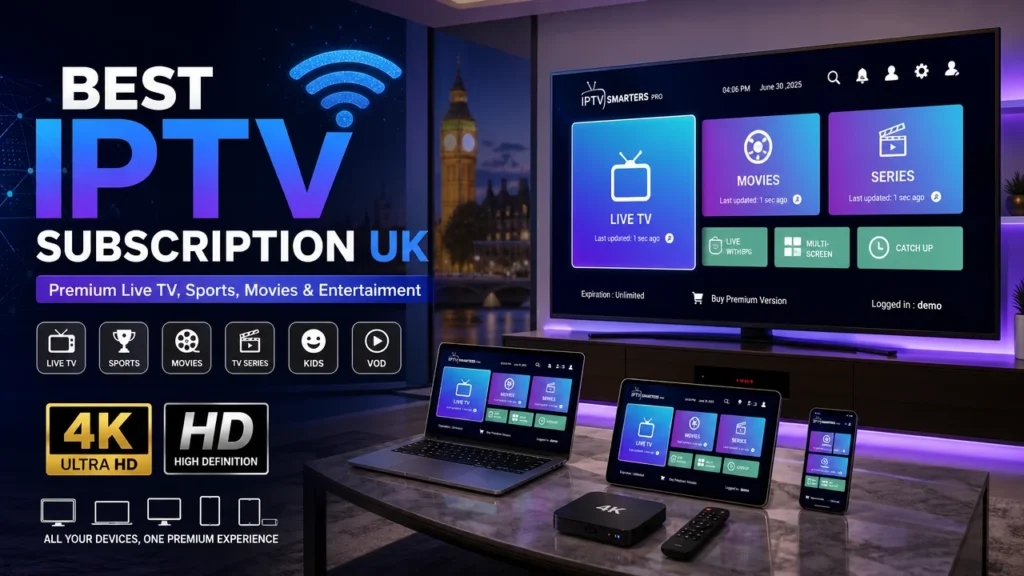
In the image below, you can see a typical IPTV interface running on a Fire Stick — one of the most popular devices for this streaming method. It gives you a familiar channel grid, live preview windows, sports categories, and quick access to thousands of channels instead of the two or three hundred you'd find on a basic cable plan.
What makes IPTV so attractive is that it replaces multiple subscriptions with a single platform. Before you commit, though, you should understand how the technology works, what format your provider uses, and how to configure everything safely. That's exactly what this guide covers — from definitions to hands-on setup steps, with a little troubleshooting insight from our team's two-year testing history.
LIMITED TIME AVAILABILITY
Unlock Full what is iptv tv Access
Secure special promotional rates instantly before the window closes. Lock in your pricing model today before plans return to standard regional metrics.
What Is IPTV TV Exactly?
IPTV stands for Internet Protocol Television. Technically speaking, IPTV is the delivery of video content using IP packets over a computer network such as the internet. Instead of a broadcaster pushing a single signal through the air, across coaxial cables, or from a satellite, IPTV sends compressed video data as packets through your broadband connection. Your device — a Firestick, Smart TV, Android box, or phone — then decodes those packets and displays them as smooth, watchable television.
The phrase "what is iptv tv" comes from people typing the redundancy into search engines. IPTV already contains the word television, so adding TV creates "television TV." But because that's how most of us actually search, it's become the standard term in the cord-cutting world.
Key IPTV Terms You'll Meet
- M3U playlist — a text file that contains the URLs of live streams, VOD items, and radio channels included in your subscription.
- Xtream Codes API — a modern connection method used by most current IPTV apps. Instead of uploading a file, you enter a server URL, username, and password.
- EPG — Electronic Program Guide, the digital TV schedule that tells you what plays on each channel and when.
- VOD — Video on Demand: the library of movies and full series that comes bundled with nearly every IPTV plan.
- Reseller panel — administrators who buy bulk access from IPTV server owners and resell individual subscriptions to customers.
How Does IPTV Work Step by Step?
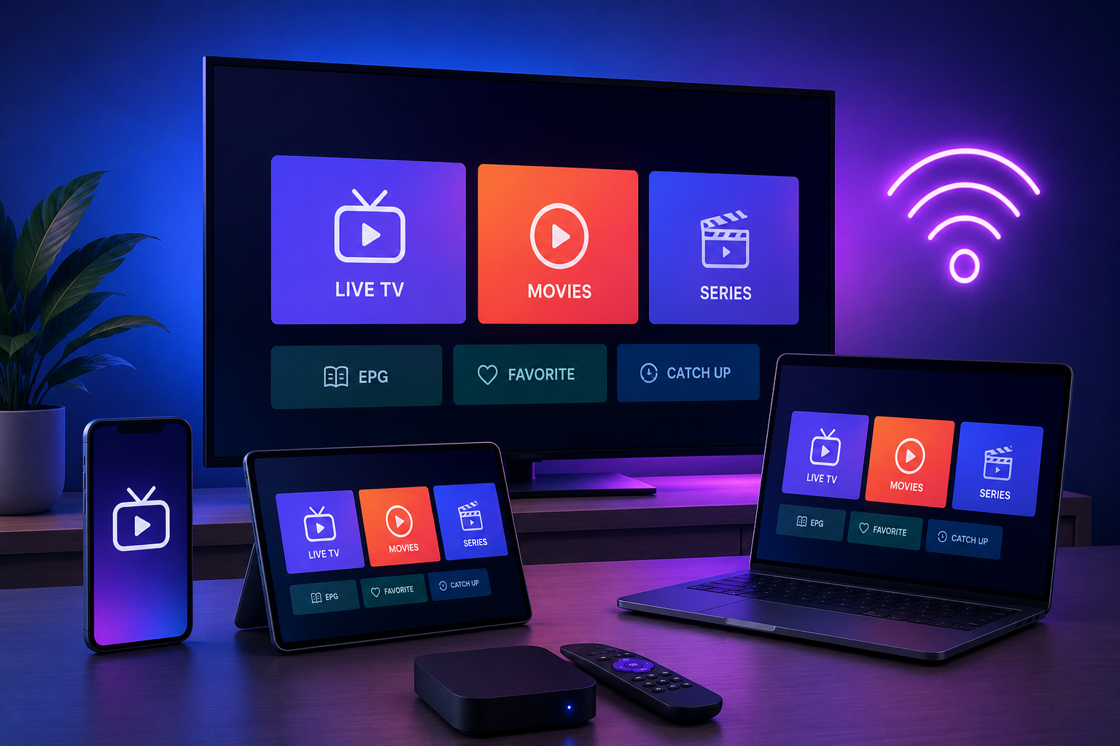
The diagram above shows the path your video takes to reach your screen. Here's what actually happens with each stream:
- Content acquisition. The IPTV provider receives live broadcast signals, typically from satellite feeds, terrestrial transmitters, or licensed digital sources.
- Encoding and transcoding. These raw signals are compressed into digital formats such as H.264 or HEVC, so they require far less bandwidth without losing perceived quality.
- IP packaging. The compressed video is broken into IP packets. These packets travel over public or private networks using protocols like HTTP, RTSP, or UDP.
- Delivery to your device. Your player app — TiviMate, IBO Player, Smarters, or similar — connects to the provider's server using the M3U URL or Xtream Codes login, then downloads channel metadata and the program guide.
- Decoding and playback. IP packets are reordered, decoded, and rendered as live television. Buffering happens when packets arrive late or get dropped along the route.
The important takeaway: IPTV quality depends on the provider's encoding settings, your internet speed, and your connection's latency — not just your TV.
Unlock complete high-definition information and priority access packs.
Claim This Special Offer for what is iptv tv →Concrete Benefits of IPTV for Real Users
Why switch from cable to IPTV? The reasons go beyond price. Here are the strongest benefits our readers and testers report:
- Massive channel selection. Most providers list 5,000 to 20,000 channels covering every continent, including local US channels, Canadian, UK, Latin American, and Asian networks.
- Price flexibility. A good IPTV plan costs $10 to $25 per month, far below cable's $60–$150 average. There's no equipment rental, no installation fee, and no annual contract.
- Device freedom. Watch on a Firestick, Smart TV, smartphone, tablet, PC, Mag box, or even a cheap Android TV box. Credentials work on multiple devices simultaneously.
- Built-in VOD library. Beyond live channels, you get movies and full seasons of TV shows already included. This alone replaces a Netflix or Hulu subscription for many users.
- International access. Expats and diaspora communities find home-country channels that cable companies never carry.
Honest Limitations You Should Know
IPTV isn't perfect, and being honest about its flaws will save you frustration:
- Internet dependence. If your broadband drops, so does your TV. Cable often still works during outages.
- Legal gray zones. White-label IPTV benefits from fair-use and re-transmission arguments, but many resold "premium" channel packages operate outside licensing agreements.
- Buffering and geo-induced throttling. ISP throttling is real, especially for heavy UDP streams. A VPN is often mandatory.
- Provider instability. Unlicensed providers disappear overnight. Never pay 12 months upfront for a provider you haven't tested.
- EPG glitches and setup quirks. Program guide data may lag or be incomplete for obscure channels; the setup process is more involved than plugging in a cable box.
IPTV Pros and Cons at a Glance
💚 Pros
- Significantly cheaper than cable
- 10,000+ channels including international
- Includes VOD movies and series
- No contract, cancel anytime
- Works across Firestick, Smart TV, phone, PC
- Multi-screen with a single subscription
- 4K/FHD streams available in 2026
💔 Cons
- Legality depends on the provider
- Buffering without stable internet
- ISPs may throttle IPTV traffic
- Provider can disappear without notice
- Setup requires reading and adapting
- EPG sometimes incomplete
- VPN adds monthly cost for safety
IPTV vs. Cable vs. Streaming Apps vs. Antenna
To see where IPTV fits, compare it against the three common alternatives in the table below:
| Feature | IPTV | Cable TV | Streaming Apps | OTA Antenna |
|---|---|---|---|---|
| Monthly cost | $10–$25 | $60–$150+ | $8–$25 per app | One-time $20–$60 |
| Live channels | 5,000–20,000+ | 100–400 | 50–150 (live-TV plans) | Local channels only (5–80) |
| On-demand content | Large library | Limited | Extensive | None |
| Contract | Month-to-month | 12–24 months | Month-to-month | None |
| Internet required | Yes (15+ Mbps) | No | Yes | No |
| Device flexibility | Firestick, Smart TV, phone, PC | Cable box only | Most devices | TV + antenna |
| Stream quality | Variable HD/4K | Stable HD | Adaptive HD/4K | 720p–1080p local |
Who Is IPTV For?
IPTV isn't for everyone, but it's a great fit for these user profiles:
- Cord-cutters — people who've left cable and want live news and sports without paying cable prices.
- Sports fans — IPTV is famous for bundled international sports packages: Premier League, NBA, NFL, UFC, cricket, and more.
- Expats and diaspora — readers who want home-country channels not available through any domestic cable provider.
- Budget-conscious families — households tired of paying for hundreds of cable channels they never watch and hardware rental fees.
- Travelers and digital nomads — IPTV login credentials work anywhere in the world as long as internet access exists.
How to Get Started with IPTV — 8 Practical Steps
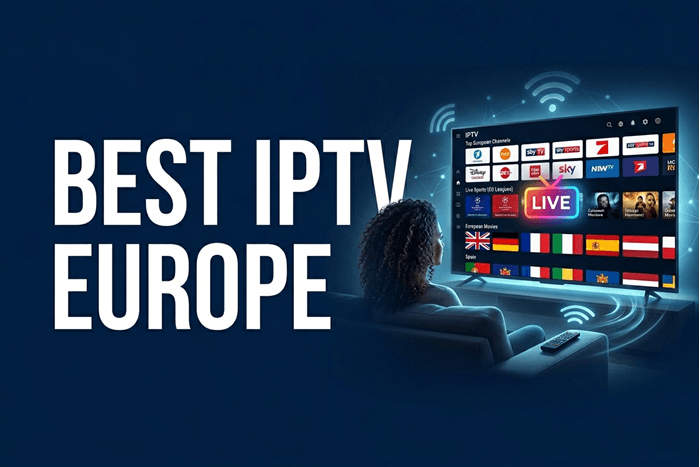
Getting IPTV working on your Firestick or Smart TV takes about fifteen minutes once you know what you're doing. The channel list in the image above shows what a quality provider's EPG should look like on a Smart TV. Here's a step-by-step guide:
- Check your internet speed. Aim for at least 25 Mbps on the device you'll use. Streaming 4K IPTV comfortably requires 50 Mbps or more.
- Choose your provider. Look for one with a live demo channel trial, a clear channel list, and payment terms by month or week — never a non-refundable annual plan.
- Pick your device. Firestick, Smart TV, Android box, and Apple TV are the most popular options. All work with the right player app.
- Install an IPTV player. Popular apps: TiviMate (Firestick), IBO Player (Android), IPTV Smarters Pro, XCIPTV, and MyGeeker. Download the one compatible with your device.
- Enter your login details. Your provider sends either an M3U URL or Xtream Codes login (server URL, username, password). Paste these into the player.
- Load the EPG. Most players auto-load the electronic program guide. If some channels show "No information," manually update the EPG URL in settings.
- Connect a VPN. A reputable VPN (Surfshark, NordVPN, ProtonVPN) helps avoid ISP throttling and protects your data when connecting to unofficial providers.
- Test and adjust. Check your favorite channels, review the VOD section, tweak buffer settings in the player, and make sure the connection remains stable during prime-time hours.
Final Subscription Window:
Get Started Today →Affiliate Disclosure: Clicking this secure link verified by our network supports our team through standard partnership terms at zero extra cost to your invoice.
Frequently Asked Questions
1. What is IPTV TV and how does it work?
IPTV TV stands for Internet Protocol Television, a service that transmits live and on-demand video over an internet connection rather than via cable or satellite. Your IPTV player app receives a stream URL from the provider, connects to their server, decodes the IP packets, and renders them as video. All that happens in real time when you press a channel. The most common connection types are M3U playlists and Xtream Codes logins; both are supported by players like TiviMate and Smarters Pro.
2. Is IPTV legal or illegal?
IPTV technology itself is completely legal. In fact, many telecom operators use licensed IPTV to serve their customers. The legality becomes complicated when a provider resells premium channels such as sports networks or pay-TV stations without licensing agreements. In most countries, watching unlicensed streams puts you in a gray zone, while selling them is clearly against the law. Sticking with reputable providers that hold distribution rights, or using IPTV only for free-to-air and well-licensed content, keeps you on the right side of the rules.
3. How much does IPTV cost per month?
Average prices vary by region and channel count, but a solid IPTV subscription ranges from $10 to $25 per month. Some providers also offer 3-month, 6-month, and annual packages that reduce the equivalent monthly price to $5–$12. As a rule, plans below $5 per month are usually unstable or oversold. Our advice: always start with a one-month trial to verify channel stability and picture quality.
4. What is the best IPTV service for Firestick?
The most reliable way to find the best IPTV service for Firestick in 2026 is to look for a provider that offers TiviMate or IPTV Smarters Pro compatibility, 4K channels, anti-freeze servers, and a 24-hour trial. Many cord-cutters select a provider based on channel variety for sports and international content, since Firestick handles those streams well. Always read recent reviews on Reddit and independent comparison pages before paying. The ideal service combines EPG accuracy, regular stream updates, and responsive customer support.
5. How do I set up IPTV on my Smart TV?
Smart TVs that run Android TV (LG webOS and Samsung Tizen require more workarounds) can install an IPTV player app directly from the Play Store. First install a player like IPTV Smarters Pro or XCIPTV, open it, tap "Add new user," and then enter your Xtream Codes or M3U details supplied by the provider. Once the playlist loads, the app builds your channel list and EPG. If your TV can't install IPTV apps natively, a Firestick or cheap Android TV box plugged into an HDMI port solves the problem for under $40.
6. IPTV vs cable TV — which is better?
IPTV wins on price, channel count, device flexibility, and freedom from long-term contracts. Cable still wins for video stability during internet outages, local channel reliability, and ease of use — you don't need to configure anything with a cable box. For most readers, IPTV is better if you're comfortable with technology and you already have stable broadband. Cable remains the safer choice for less technical users or those living in areas with poor internet quality.
7. Can I watch IPTV on multiple devices at the same time?
Yes, practically every IPTV provider allows multi-screen viewing. Entry plans usually support one to two connections, while premium plans can handle up to five or more. This feature is worth checking before you pay — not all resellers include the same number of connections. Multi-device also means you can start watching on your TV, pause, and resume on your phone during a commute, as long as your provider's panel supports it.
8. Where to buy IPTV subscription safely?
The safest method is to buy through providers that offer transparent monthly pricing, a 24-hour test account, and contact methods outside of Telegram alone. Look for websites with payment processors like PayPal or card payments with buyer protection, because they indicate greater accountability. Independent reviews on Reddit and YouTube can help you identify red flags that scam resellers share. Start with a one-month plan (we recommend the partner offer linked on this page if you want a tested provider) and only renew once you're satisfied with stream stability and picture quality.
Final Thoughts: Is IPTV TV Right for You in 2026?
The television landscape has shifted dramatically over the last decade. What used to require a satellite dish and a 24-month cable contract now runs through an app on a $40 Firestick. IPTV TV is the main driver of that shift, giving cord-cutters instant access to international channels, 4K sports, and VOD libraries at a fraction of cable prices.
At the same time, IPTV is not a one-size-fits-all magic bullet. You need a stable broadband connection, a willingness to invest a little time in setup, and the judgment to pick a provider that doesn't overpromise on channels or reliability. If you'd like to try a service we've already tested and verified, the partner link above can get you started with a special promotional rate window.
Start small, test the stream on your favorite channels, and once you confirm it feels right, enjoy the television setup you should have had years ago.